Object First
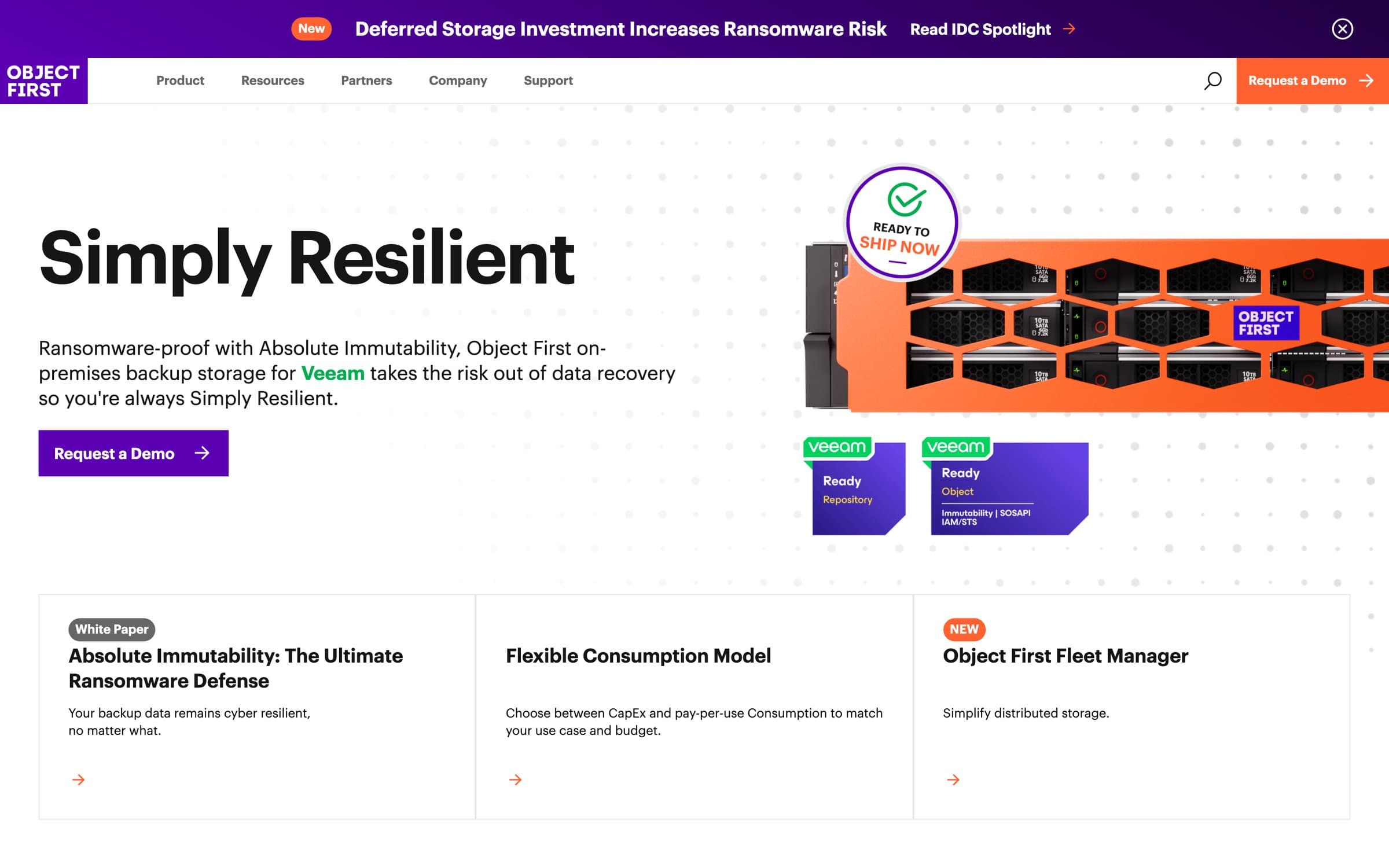
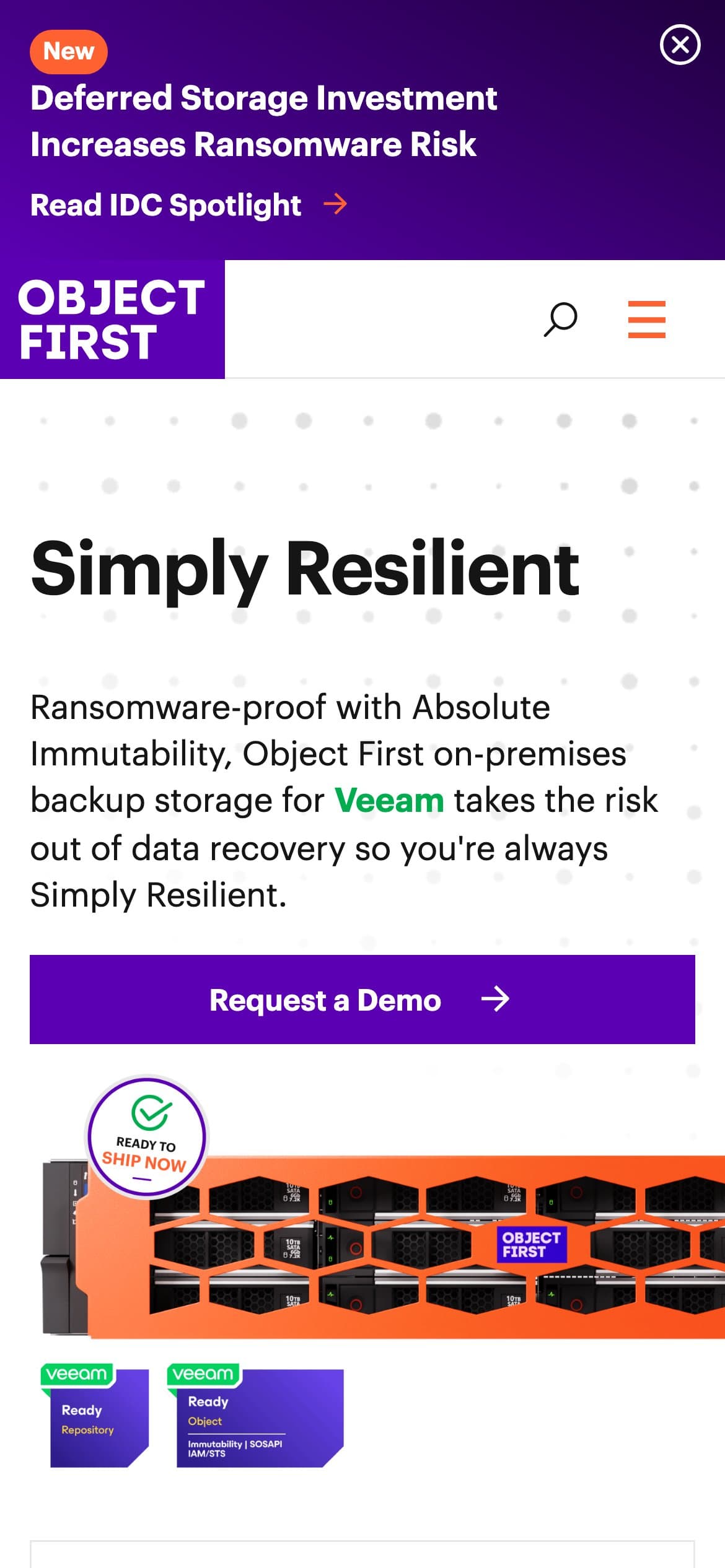
External web team for the vendor: 50+ landing pages in 6 languages, layered bot protection on every form and +291% bookings YoY - up to January 2026, when Veeam acquired the company
For two years we ran the entire landing page infrastructure behind Object First's paid traffic, webinars and content - up to January 2026, when the company was acquired by Veeam.
- Industry
- B2B SaaS · data protection (Veeam ecosystem)
- Location
- United States + EU
- Profile
- Embedded web team on retainer
- Timeline
- June 2024 - January 2026 (~2 years)
Challenge
Object First was scaling demand fast through PPC, webinars and content, and the landing page infrastructure had to keep up: a new page for every campaign, in several languages, with clean lead hand-off to Salesforce and Pardot and correct attribution. At the same time the paid traffic problem of the security niche kept growing - bots and junk leads that burned budget and clogged the funnel.
Strategy
We embedded as an external web team with steady capacity and a daily sync with the client's marketing and PPC teams. The point was not to ship a website but to keep a living conversion system running: a library of reusable components, one landing page template, layered lead protection and end-to-end tracking built into every page by default.
- Every new landing page was built almost from scratch - slow campaign launches
- Paid traffic brought in a stream of junk leads from bots - money down the drain
- Marketing did not trust the numbers in the funnel
- Lead hand-off and click to lead to deal attribution were incomplete
A landing page for paid traffic is not just a page. It is the first filter for lead quality and the one place where you cannot afford to lose a single submission.
What we did, by channel
- 50+ pages: PPC landing pages, webinars (Monthly Product Demo), event registrations (VeeamON Tour), gated video, quizzes
- 6 languages: EN / DE / FR / ES / IT / PT-BR
- One shared template plus a brand refresh across the whole library
Why: With one template a landing page ships in hours, so PPC launches campaigns without waiting on development.
- Custom email OTP verification
- Honeypot traps: decoy fields, detection of submits that come in too fast
- Cloudflare Turnstile CAPTCHA and a block on loading the page in an iframe
Why: Junk leads from bots were the top priority for PPC. The layered defense cut the noise without hurting conversion for real users.
- Forms → Object First API → Salesforce + Pardot/Marketo
- Zoom for webinars; GTM events + GA4
- SegmentStream and cross-device attribution (e-hash)
Why: Marketing needs the full click to lead to deal picture and a clean nurture flow in Pardot - without it there is no revenue attribution.
- Quizzes built on InputFlow
- VMCE practice exam: 30 questions with result sharing to LinkedIn
- NIS2 and Ransomware Resilience quizzes
Why: An interactive step qualifies a lead better than a static form, and sharing to LinkedIn adds organic reach.
- Form refactor: validation, debounce, timeouts, fallback when the CDN fails
- Core Web Vitals in the green
- Supply chain: third-party JS moved to controlled hosting
Why: A landing page is the entry point for paid traffic, so a broken form is a direct loss. Not a single registration gets lost.
A closer look
Project numbers
The metrics are real; some are under NDA and shown in a call.
What did not work and the risks
The decisions we rejected and the risks we planned for in advance.
- The 2FA pages became a target themselves: OTP cut the junk, but bots switched to attacking it, so we had to layer honeypots and CAPTCHA on top. Lead protection is a process, not a one-off feature.
- Dependency on third-party CDN libraries: after an incident that took the registration form down, we added timeouts and a fallback so an external failure cannot break conversion.
- Supply chain hygiene: third-party JS served from a public repository is a risk - we found it and moved it to controlled hosting.
Takeaway
For two years we ran the whole conversion infrastructure of Object First - from landing pages in 6 languages to layered lead protection and end-to-end tracking. Over that period the client grew several times over (+291% YoY bookings, Q3 2025) and in January 2026 was acquired by Veeam, the global leader in data protection. For us it confirms the embedded web team model: not a one-off website, but a living system that keeps up with a fast-growing B2B marketing team.
“The Bankai team just closes questions. We come in with something custom and they immediately suggest a better way to do it. That is why we have been working together for years now.”
Next case

Let's see what from this case will work for you
We show where you lose clients on your own numbers and lay out a plan for a steady flow of leads.
The audit is free and comes with no obligations.